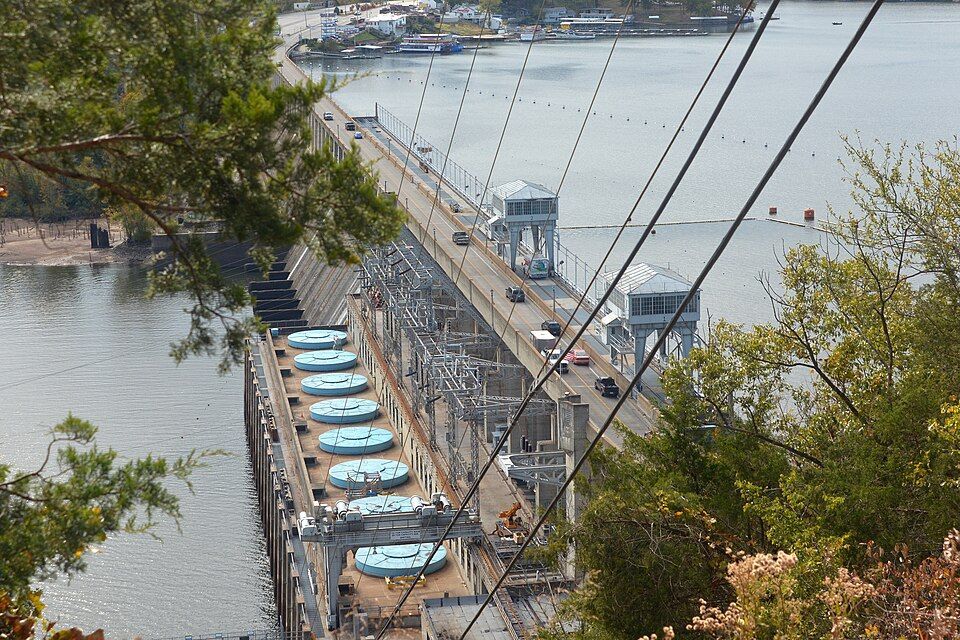

Bagnell Dam: Lake Ozark, MO's National Register Landmark
Bagnell Dam rises 148 feet above the Osage River at the edge of Lake Ozark, Missouri, forming a concrete backbone that has shaped the region for nearly a century. The structure stretches 2,543 feet across the river valley, making it one of the largest concrete gravity dams built in the central United States during the early twentieth century. For residents of Lake Ozark and the surrounding Lake of the Ozarks community, the dam is not simply a scenic backdrop; it is the reason the town, the lake, and the surrounding built environment exist at all.
A Depression-Era Engineering Achievement
Construction on Bagnell Dam began in 1929, just as the national economy was collapsing into the Great Depression. Union Electric Company, working with the engineering firm Stone & Webster, completed the project by 1931 after roughly two years of continuous work. Thousands of laborers relocated to the Ozarks to build the dam, and the project became one of the region's few reliable sources of employment during a period of widespread economic hardship.
The dam's design classifies it as a concrete gravity dam, meaning its own weight, rather than an arched or embankment shape, holds back the force of the impounded water. This construction method requires enormous volumes of concrete and precise engineering calculations to withstand constant hydrostatic pressure. The choice reflected both the engineering standards of the era and the practical need for a structure durable enough to operate for generations without major redesign.
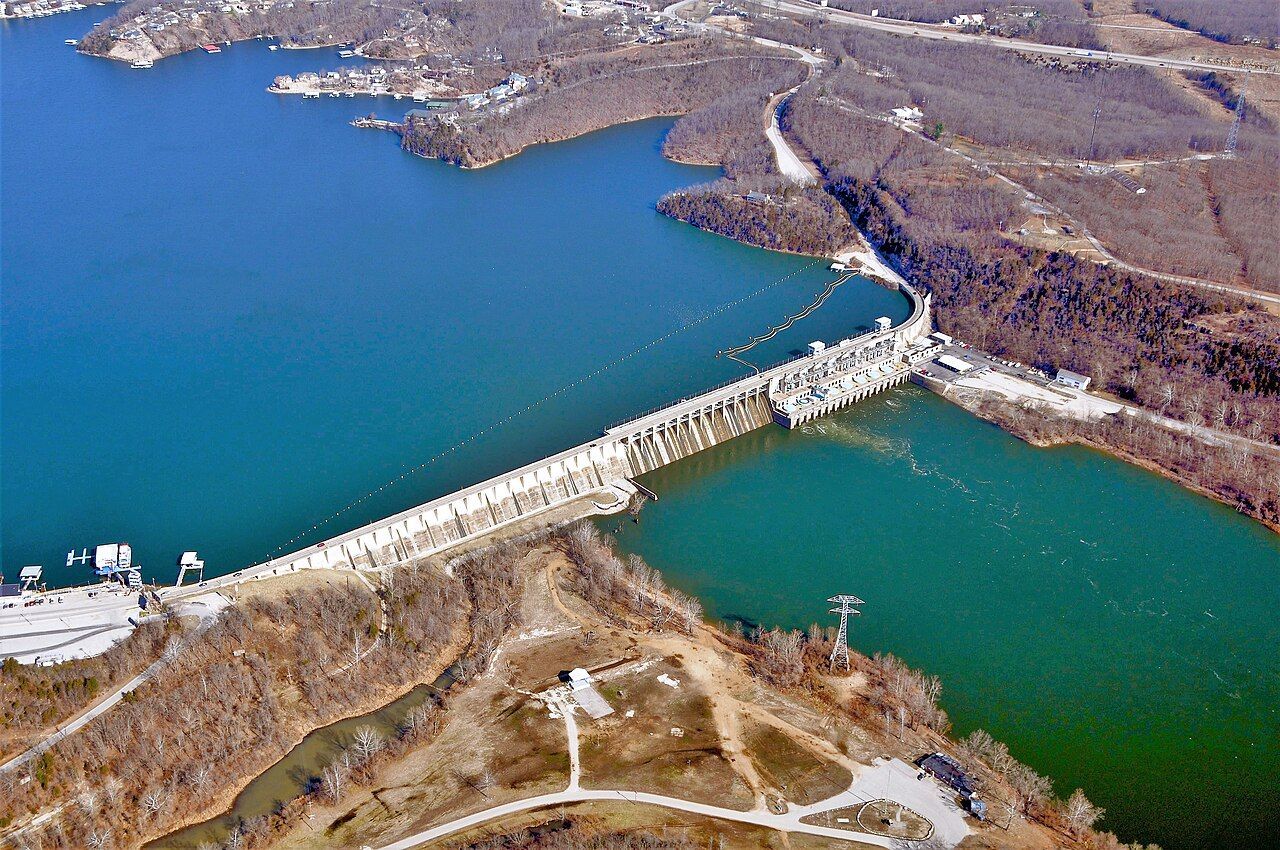
Image credit: KTrimble, CC0, via Wikimedia Commons
From River Valley to Reservoir
Damming the Osage River created the Lake of the Ozarks, a reservoir that covers approximately 55,000 acres and has more than 1,150 miles of shoreline. At the time it was completed, it ranked as the largest man-made lake in the United States and one of the largest reservoirs of its kind in the world. That transformation turned a rural river valley into one of the Midwest's most significant recreational and residential waterways, directly shaping the layout of the town of Lake Ozark that grew up beside the dam.
The rising water did more than create shoreline; it submerged entire communities that stood in the path of the new reservoir. The original town of Linn Creek, which had served as the Camden County seat since 1855, was inundated once the reservoir filled, and its residents rebuilt at higher ground under the same name. County government relocated as well, moving to the newly established town of Camdenton in 1931, a shift that permanently redrew the region's map.
Beyond recreation, the dam continues to serve its original industrial purpose. Eight generators housed within the dam produce hydroelectric power with a maximum capacity of 215 megawatts, enough to supply electricity to roughly 42,000 homes. That dual identity, as both a power-generating facility and the anchor of a major lake community, is part of what distinguishes Bagnell Dam from many other historic structures in Missouri.
National Register Recognition
Historic significance under the National Register of Historic Places is not determined by age alone. According to National Park Service guidance, a property must meet at least one of four established criteria, association with important historical events, connection to significant individuals, distinctive architectural or engineering design, or the potential to yield important historical information, while also retaining integrity of location, design, setting, and materials. The Union Electric Administration Building at Lakeside, part of the Bagnell Dam complex, was added to the National Register in 1998, with its boundary expanded in 2011 to reflect a fuller picture of the site's historical footprint.
That designation formally recognizes what area residents have long understood: the dam represents a distinctive piece of engineering history tied directly to the economic and physical development of the Lake of the Ozarks region. Listing on the National Register does not restrict private property elsewhere in the community, but it does create an official record acknowledging the structure's architectural and historical importance at the state and national level.
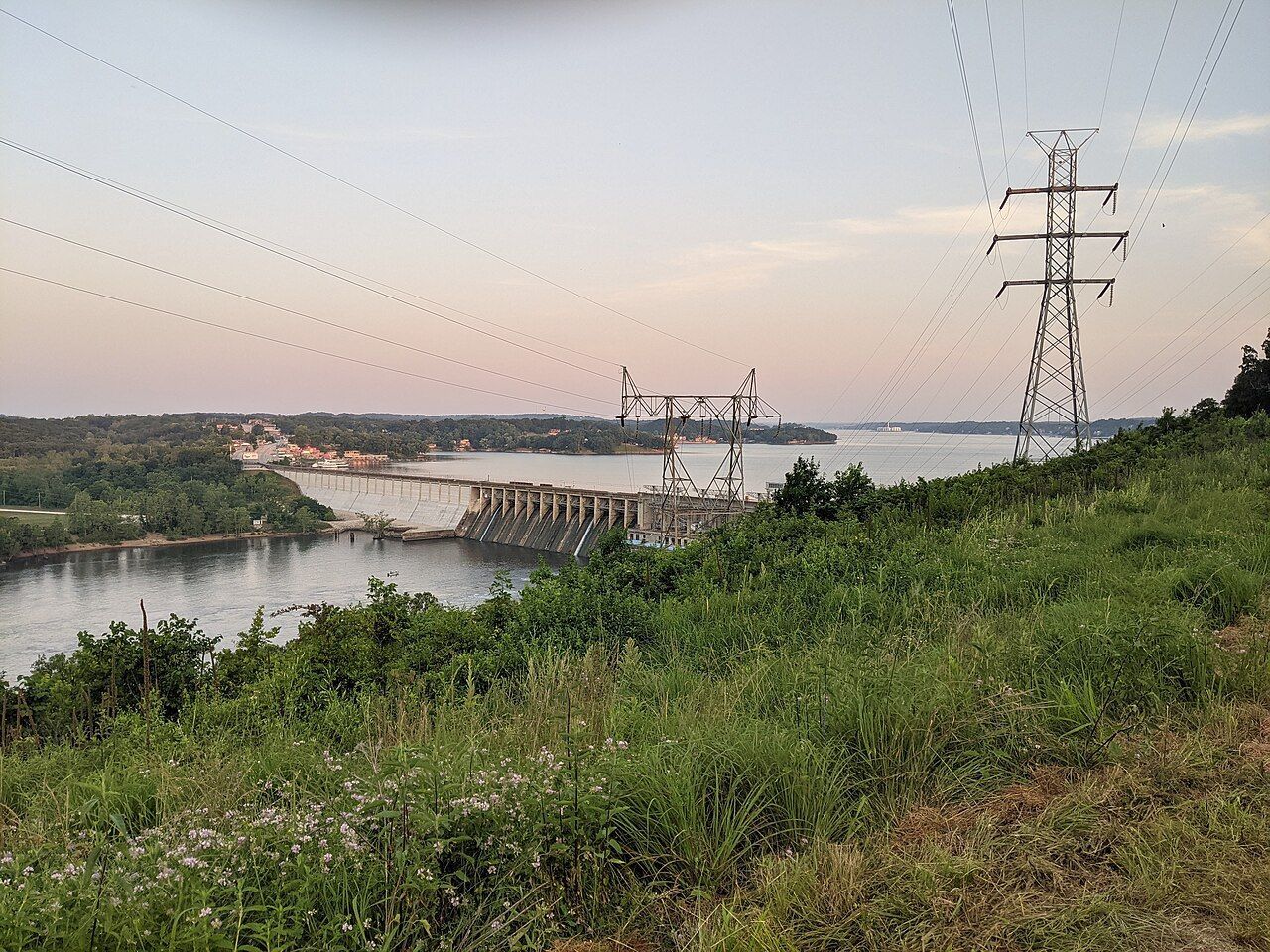
Image credit: Unifadenfisch, CC BY-SA 4.0, via Wikimedia Commons
Climate, Weathering, and Long-Term Maintenance
Central Missouri's climate places sustained physical demands on large concrete and steel structures, a factor engineers accounted for from the outset and continue to manage today. The region experiences a humid continental climate with hot, humid summers and cold winters, conditions that produce repeated freeze-thaw cycles each year as temperatures swing above and below freezing. Water that seeps into small cracks in concrete expands when it freezes, gradually widening those cracks over decades of exposure, a process engineers refer to as freeze-thaw deterioration.
Spring and early summer bring another challenge: central Missouri sits within a corridor prone to severe thunderstorms and hail, conditions that affect structures throughout the Lake of the Ozarks area each year. These combined pressures, freeze-thaw cycling, storm exposure, and near-constant contact with moving water, mean that even a structure engineered to Bagnell Dam's standards requires ongoing inspection and reinforcement. A major structural rehabilitation completed in 2017 added an estimated 66 million pounds of additional concrete to the dam at a cost of roughly $52 million, addressing decades of accumulated wear. A separate rehabilitation of the roadway bridge atop the dam took place between September 2021 and April 2022, underscoring that even a National Register landmark requires continual upkeep rather than one-time preservation.
A Landmark That Continues to Define the Region
Nearly a century after its completion, Bagnell Dam remains functionally active, generating power, regulating the Osage River, and carrying vehicle traffic across its span, while also standing as a formally recognized piece of American engineering history. Its dual role as working infrastructure and historic landmark is relatively unusual; many National Register properties are preserved specifically because they are no longer in active use, while Bagnell Dam continues operating much as it did when Union Electric completed it in 1931. For the town of Lake Ozark, the dam is both the origin point of the community's history and a continuing reminder of how engineering, economic necessity, and the region's demanding climate have shaped the landscape together.